Fred's Creative Woodworking Gallery
Click images for larger view.
GALLERY PIECES
I enjoy working with wood. My favorite woodworking tool is the lathe. Following are some of the pieces that I have made recently using my lathe that I felt were worthy of your perusal.
Included with the names of the pieces are the year they were completed, measurements, a story about the piece, and sale prices. All measurements are in inches (greatest length, width and height) and are approximate. If you left-click on the photo, an enlargement will open.
Most of these pieces are for sale by contacting me directly regarding availability of the piece. The prices for each item are listed at the end of the narrative for that item. Prior to purchasing an item from my Gallery if you wish to contact me for more specific information about the piece, please do. Many of these that I have in my Gallery are sold but I can make you a similar one if you like the style of one that is already sold.
I am now taking commissions for gift pieces. If you have someone special for whom you would like to have a piece made, please contact me and we can work out the details. I can make a variety of items to your specifications.
RECENT NEW PIECES include "A Touch of Covid-20", "Eight", "Risk It", "Carved, Turned, Maple Vessel", "Black Cherry Sphere", "Dyed White Ash Bowls, "Boob Tree Bowls", and "Four Spheres Falling", here on my Gallery page and Baseballs and Bats on my Sales page.
Be my guest in examining my most recent pieces. Please leave me feedback after you have viewed items.
If you wish to purchase any of these items using personal checks or a credit card, please contact me. If you wish to use PayPal, I can invoice you for the cost. All Gallery items are subject to an actual shipping cost per order. I generally ship by USPS Priority unless authorized to use another service. Thanks! Fred
"LIKE" FRED'S CREATIVE WOODWORKING ON FACEBOOK!
GALLERY

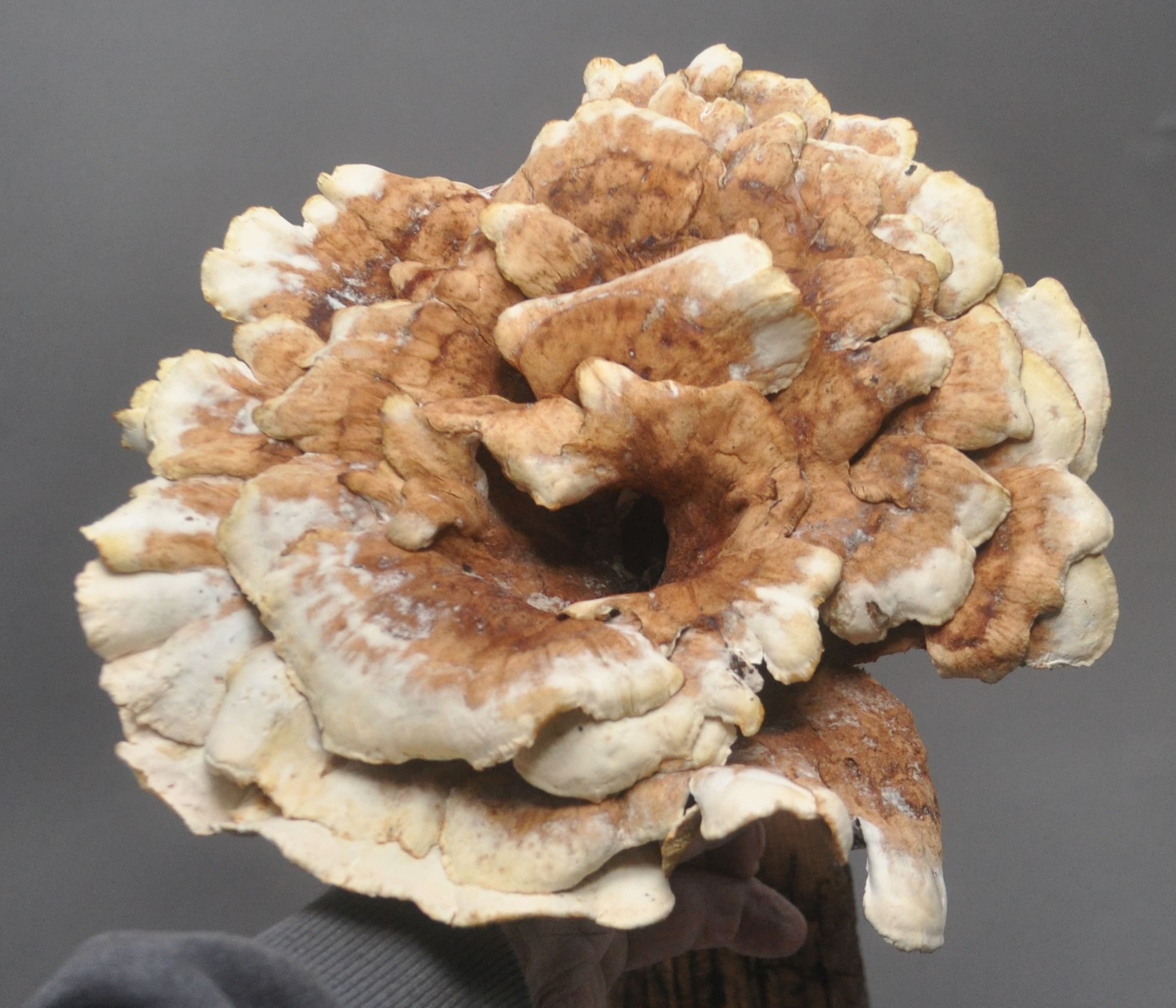 Berkley's Polypore in vase (2021) (17" X 10").This is a most unusual vase and “flower”. I make the vases like this from Black Locust fence posts that have served their usefulness and are retired to my shop. After cutting a piece of the post of sufficient length, I drill a hole in the top end and then turn the shape on my lathe. The “flower” is something else! It isn’t a flower after all but the fruiting body of a large mushroom. A friend found the mushrooms and told us about them and Val and I harvested them. The mushroom is a Berkley's polypore. It is interesting in that when it gets full-grown (as in this example) it dries and becomes very much like thin leather. The patterns on it and the shape are spectacular! This display will make a unique gift for someone who has everything! At the left is the polypore in a vase, at right is the polypore as viewed from the top. Price $85.
 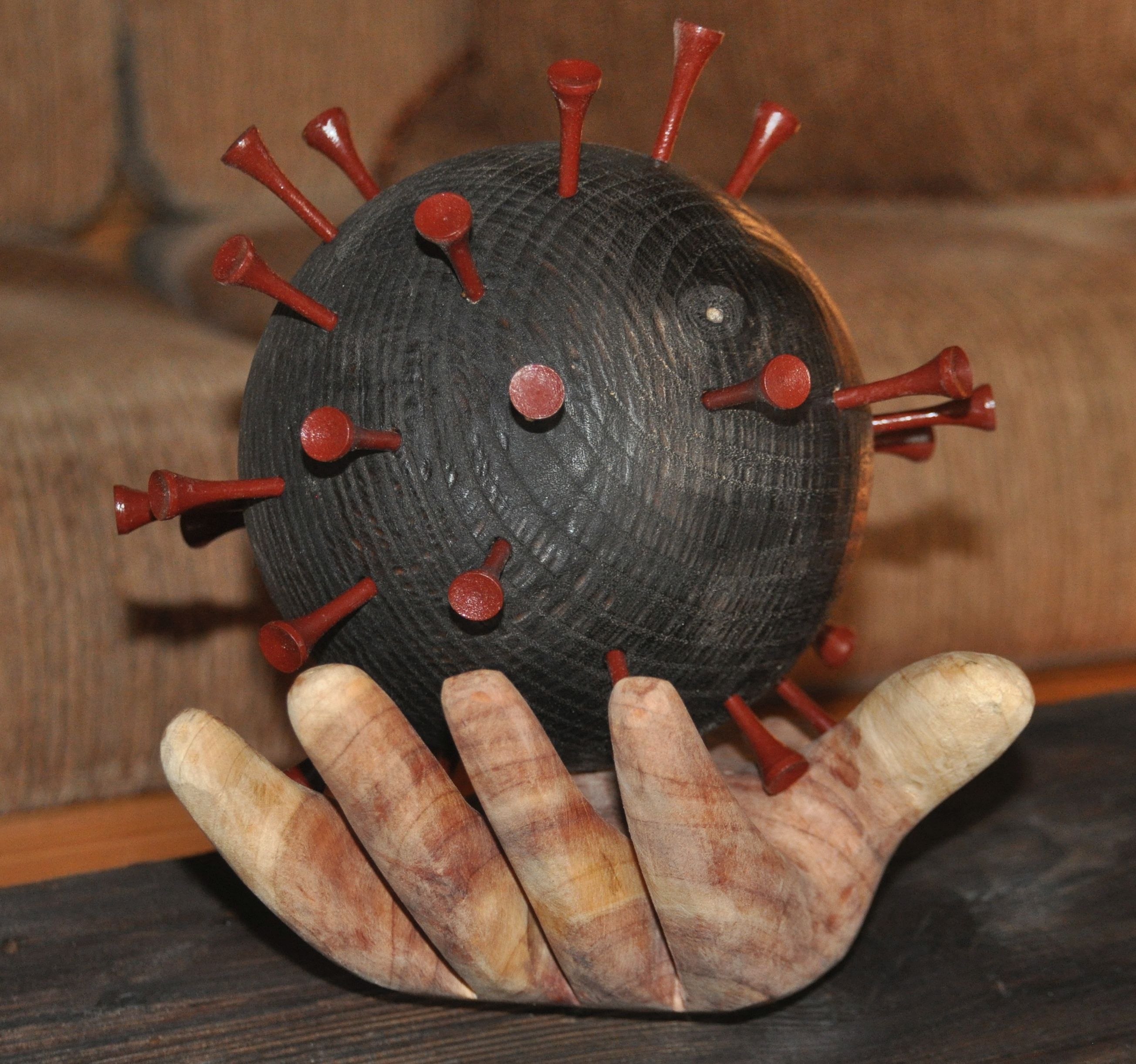 A Touch of Covid-20 (2020) (8" X 8"). The inspiration for this one is obvious. I had lots of time on my hands and thought about what else I might have on my hands. After using liberal hand-sanitizer to get rid of whatever might be there, I began this project. Ok, it is Covid-20 to set it off from the better-known Covid-19. The '20 comes from the fact that this one was made in 2020. The sphere is turned from White Ash that I ebonized. I used dyed golf tee's for the protein spikes. I invented a jig that allowed me to position the protein spikes evenly! The real brillance of this one is the hand. It is hand-carved (how else would you carve a hand) out of Red Cedar. The Cedar was the perfect wood for this project as it carved nicely but also looked a bit like flesh. While carving this one I frequently had an eerie feeling that I was actually looking at a human hand. This art would look great in an executive's office or a library! Price $250.
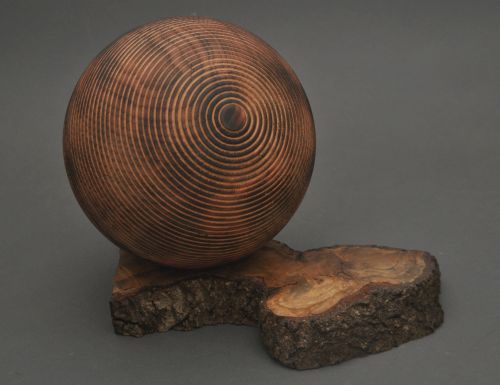 Eight (2019) (Sphere 8", Base 12"X 8" X 1"). The name for this one is obvious! This 8-inch sphere was turned from the same Black Cherry as Risk It (below). However, Eight is solid, not hollow. It, like Risk It, has natural cracks in its side which I enhanced. It also has many carved parallel grooves in its side. This one was also flame ebonized to highlight the appearance of the wood. It sits loosely on a turned, carved, Red Oak base. Price $225.
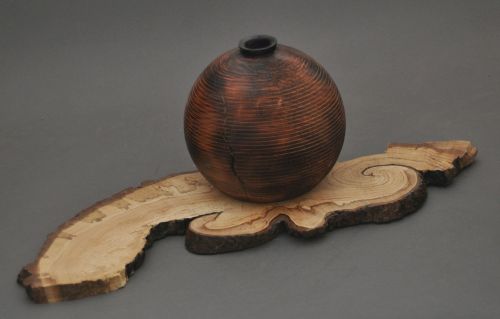 Risk It (2019) (Sphere 7", Base 21" X 8" X 1"). Risk It got it's name from the fact that I tried a new approach on this sphere- and it worked! The 7" Black Cherry sphere is hollow and has an opening at the top. There is a rather large, natural crack in its side. Also, I carved several parallel grooves in its side to add interest. The sphere was then flame ebonized to give it the interesting appearance. The base is from a Maple burl that I slabbed with my bandsaw. The two pieces are attached permanently.
Price $225
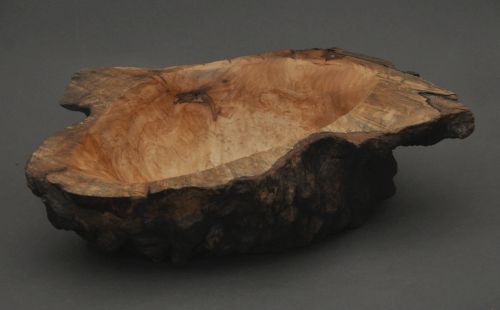 Carved Turned Maple Burl Vessel (2019) (13" L, 9" W, 4" H). I first turned the depression in this vessel then hand-carved the oval shape. The outside is flamed. The rim of the bowl, in contrast to the refined inner depression, still shows the chainsaw cuts from when the burl was rough-cut. The wood is a burl with very interesting figure. Price $175.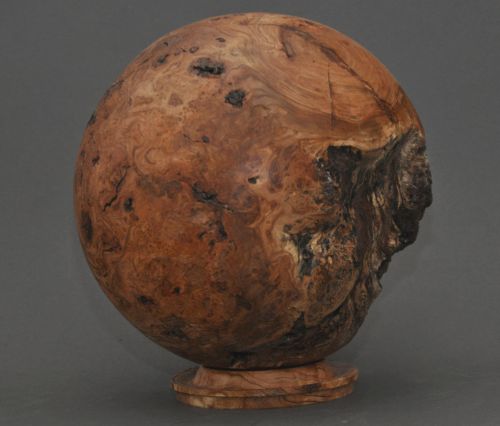
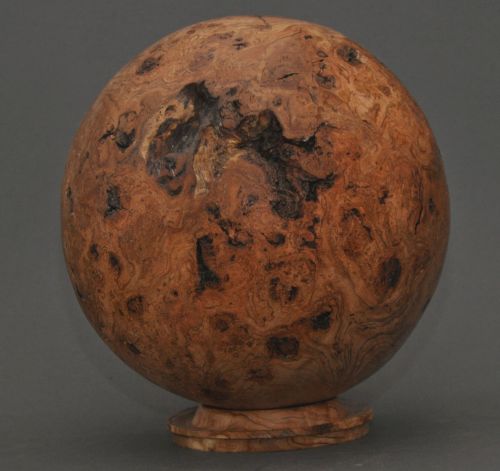 Black Cherry Sphere (2019) (7"). This sphere is made from a large Black Cherry burl that had a large rotted portion. The sphere was very difficult to turn because of the various distortions in its surface. It rests on a piece of the burl. Price: $180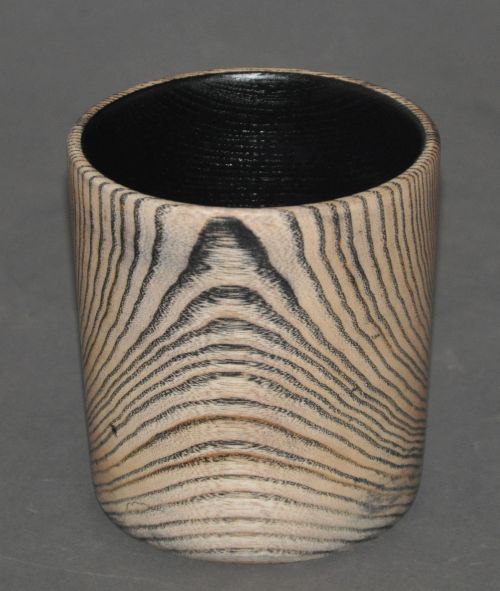
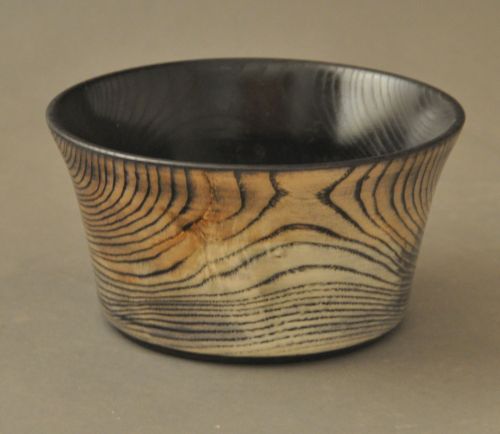 Dyed White Ash Bowls (2018) . White Ash is my go-to wood when I want to make a statement with color and/or pattern. It has an incredible grain and does well with dyes, stains etc. These two White Ash vessels show exactly what I'm talking about. Both have the inside ebonized and both have the outside modified to show the incredible grain pattern in the wood. Price: $80 for each one ($150 for the pair).
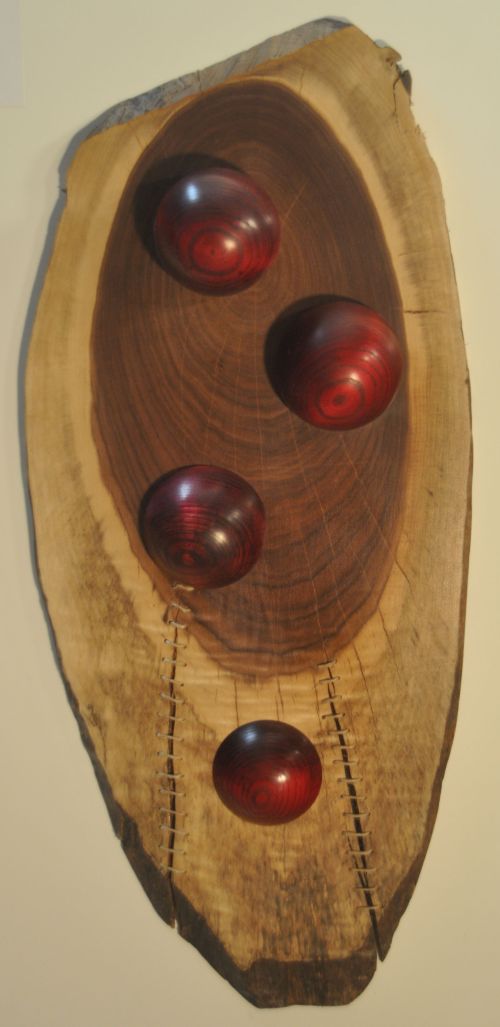 FourSpheres Falling (2018) (25" X 11") This piece is a wall hanging. The board is a slice from a bump on a Black Walnut log that I sawed some time ago. As usual, these pieces crack when they dry and shrink. I like to take advantage of these cracks by using my stitching to "sew them up". The light-colored wood is Black Walnut sapwood and the dark is Black Walnut heartwood. They shrink differentially so the sapwood cracked but the heartwood didn't. There are four demi-spheres on the piece. They were cut from two spheres I made out of White Ash. The spheres were then dyed to produce the rich red color. The two spheres were sectioned to produce the four demispheres. The back of the piece has a recess which allows it to be hung from a nail or screw in the wall. . Price $250.
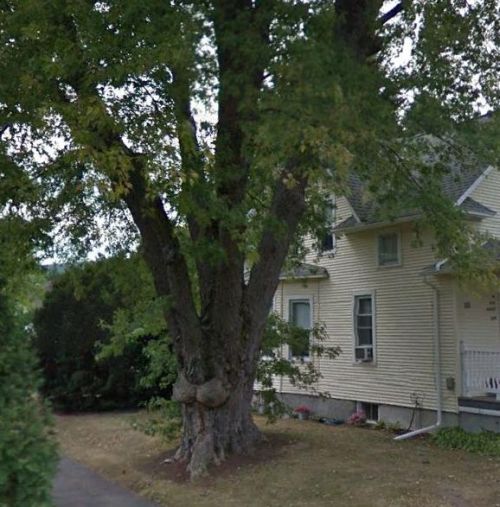
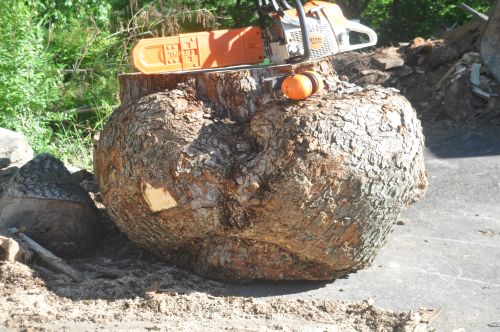
 Boob Tree Bowls (2017) (16.25" X 6.5" and 17.5" X 8.25"). Several months ago I was commissioned to turn two large bowls from a very unusual tree. This process takes many months as I have to rough-turn the piece first and let it stabilize to an equilibrium moisture content and then finish turn the piece. The tree is a soft maple (Silver Maple) that grew in Canton, PA. It was dying and was hanging over a house so it required the services of professional tree surgeon to remove it. It had two very large burls on its side that resembled very large breasts. The tree was affectionately known by those in the know in Canton as the "Boob Tree". At any rate I turned two bowls from the burls for the lady who owned the tree. They are pictured below. To the far left is the tree as it stood next to the house of the owner. Next is a photo of the massive stump that was delivered to me by the tree surgeon who cut the tree down. For perspective, my shainsaw has a 20" bar. The first bowl on the left (the "left boob") turned out to be 16.25" wide and 6.5 inches tall. The next one (the "right boob") is 17.5 "wide and 8.25" tall.
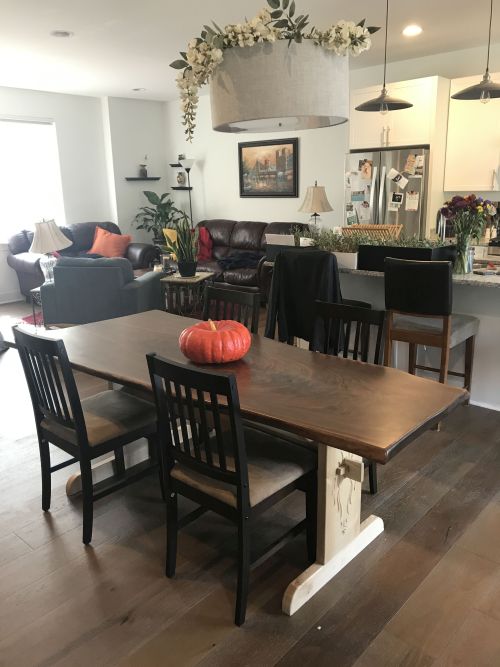
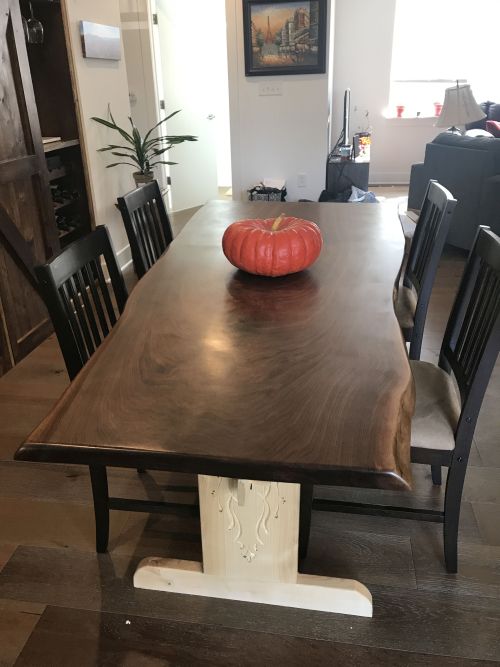
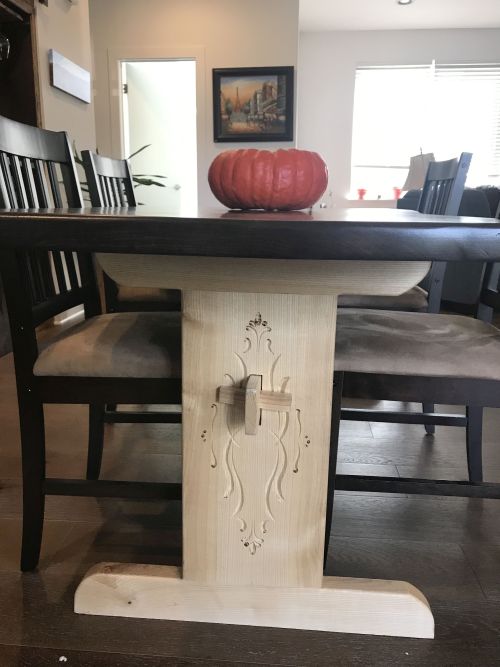
Black Walnut Table (2017) (6.5' L X 36" W X 30" H). I made this table for our son, Frederick A and his new wife, Sarah for a wedding present. The photo at the left shows the entire table (I didn't make the chairs but I grew the pumpkin!). The second photo shows the live edge of the table top. The third photo shows the carving that I made in the leg plus the wedge used to tighten the trestle. The fourth photo shows the beauty of the walnut top. This is a magnificent piece that will be an heirloom. I signed and dated the piece on the bottom of the table top. The wood is Black Walnut on top and the legs are White Ash.
If you are interested in my making a table of this type, get in touch with me.

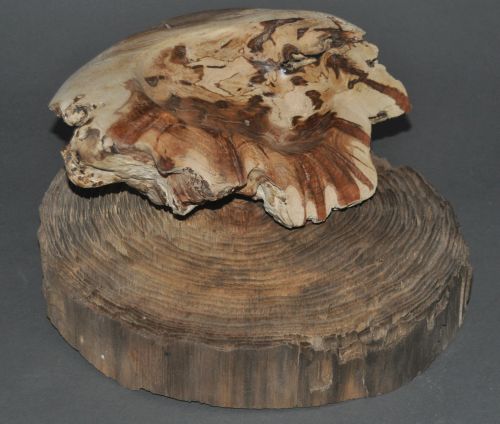 Maple Burl on Marine Post (2017) (12" D X 6") I had a second piece of the maple burl that I used to make Joas Maple Burl (2016) and carved it into another unique, stunning piece. I’ve coupled this piece with the top of a marine post from North Carolina. The marine post is sandblasted to reveal the growth rings in the wood. The two complement each other in a very unique way. A truly fascinating one-of-a-kind beautiful sculpture! Price $425.
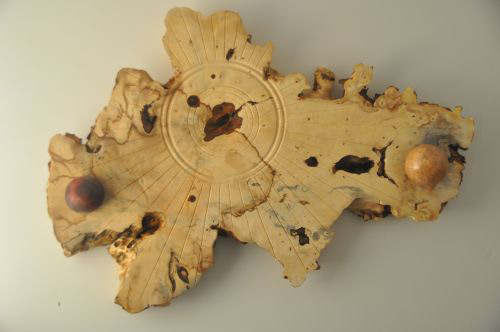 Red Planet (2017) (27" X 19") is constructed from a large slab of California Buckeye Burl. It depicts the Cosmos with a star forming inside the rings. Two planets circle the star but the important one is the Red Planet. This is where life originated. I turned the piece on my lathe and hand-carved the rays. The two planets, one composed of Black Cherry and the other of dyed White Ash (yellow, blue, red dye) are attached to the surface of the burl. It is a wall hanging with two recesses in the back that allow it to hang on a nail or screw in the wall. This is a stunning one-of-a-kind piece! Price: $350
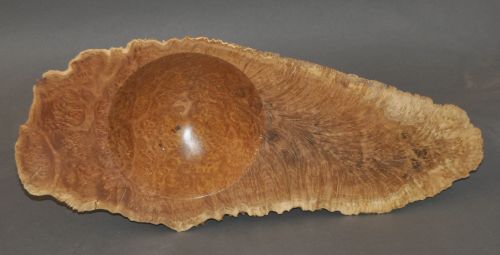
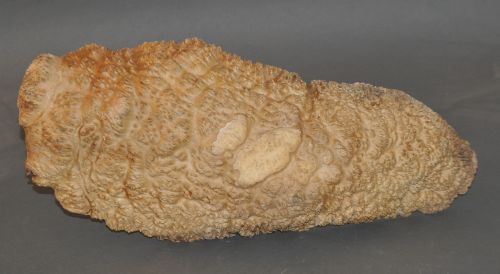
Brown Mallee (2016): (18.5" X 8" X 3"). Brown Mallee is another of the incredible burl woods from Australia. These burls are harvested from live trees and the tree isn't destroyed in the process. This piece of burl is very interesting in that the brown streaked rays seem to explode from the depression which I turned in the vessel (left photo). It has the natural outside showing the "bumps" associated with burl wood and, because of the way in which I turn these, there is no evidence on the bottom of the vessel that it was attached to the lathe (right photo). As with all of my art, this one is named, hand-signed, and dated. It is a spectacular piece worthy of display in the finest settings. You will be proud to own this one! Price: $375.
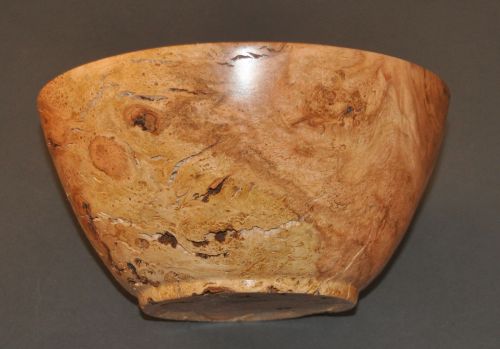
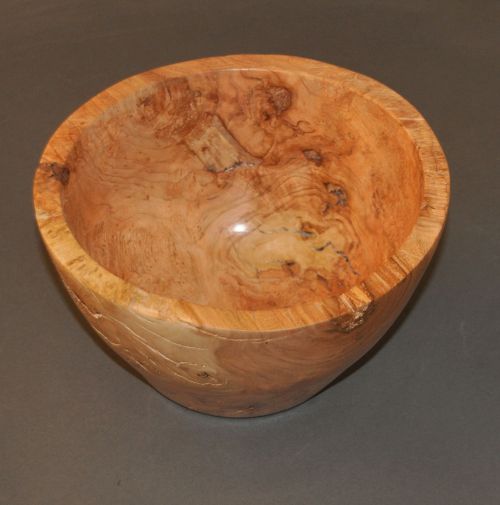
Black Cherry Burl Bowl: 2016 (10" Diameter 9" H) This is one of several Black Cherry Burl vessels that I've turned from large burls. I left the rim of the bowl rough which adds to the character of this vessel. Note the irregular patterns throughout the wood that, along with the stunning color, make these very unique turnings. Price $250. sold

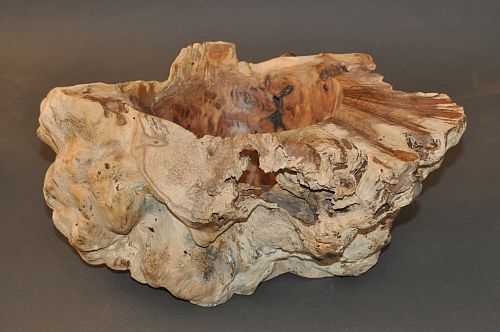
Joas Maple Burl: 2016 (10" D 9" H). This is a very unique burl. It has large nearly golf ball sized growths on its surface which lend a very unique appearance to the burl. The inside is also spalted with various shades of reddish brown streaks running through it. It is another of the very unique pieces that I've turned lately. Price $425 sold
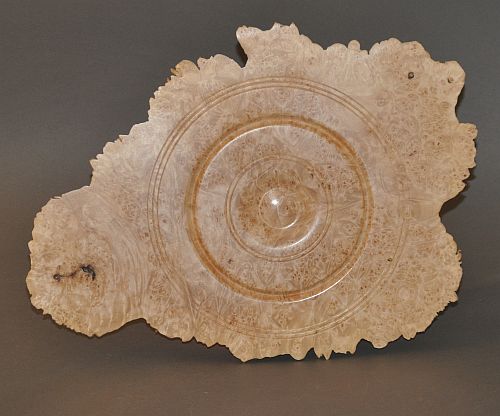
 Bigleaf Maple Burl wall hanging:2016 (16" X 11" X 1.25"). Bigleaf Maple burl is well known in the woodturning industry as one of the spectacular burls. This one is incredible! The surface is glass-smooth and silky to the touch. This piece can be used as either a wall hanging or a very unique, attractive table decoration. I have 4 holes in the back of the piece that allow one to safely hang the piece on a wall in any position. This is definitely a conversation piece worth owning! Price $225.
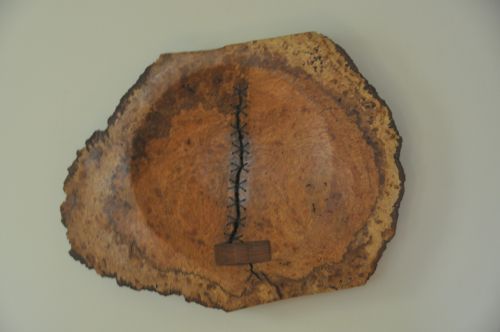 All It's Cracked Up To Be: 2016 (22" X 17" X 1.5"). Red Oak burl with major crack (stabile) in the middle. If you haven't figured out yet, I love to have fun with pieces. this one has large leather stitches holding the crack together and also a Black Walnut bandied at the bottom of the crack to cover the "owie". As with all of my wall plaques, I have a "hanging hole" drilled in the back of the piece. This wall plaque is stunning hanging on a wall but would be equally at home sitting on an elegant table as a centerpiece. This piece came from a huge Red Oak burl that I rescued from a local farmer. Price: $550
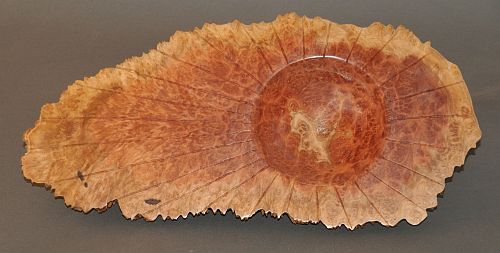
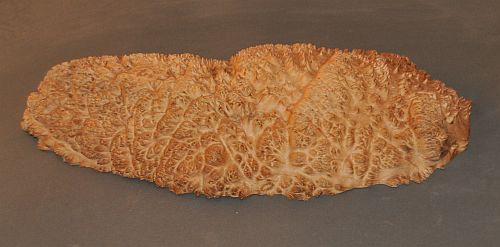 Red Mallee 1654: 2016 (17" X 8" X 3"). Red Mallee 1654 is turned and hand carved from a piece of Australian Red Mallee burl. The turned depression in the piece is approximately 2" deep and 4.75" wide. The figure of this piece is incredible and the sun rays I hand carved add elegance to the piece. Truly a spectacular piece! The view on the right shows the bottom of this piece. I have developed a method that allows me to turn pieces such as this without leaving any evidence of them having been attached to the lathe. I created a small flat area on the bottom that allows the vessel to sit nicely on a flat surface. Also, this small spot allows me to sign the vessel. This is a very nice piece that would look marvelous in your home. Price $350
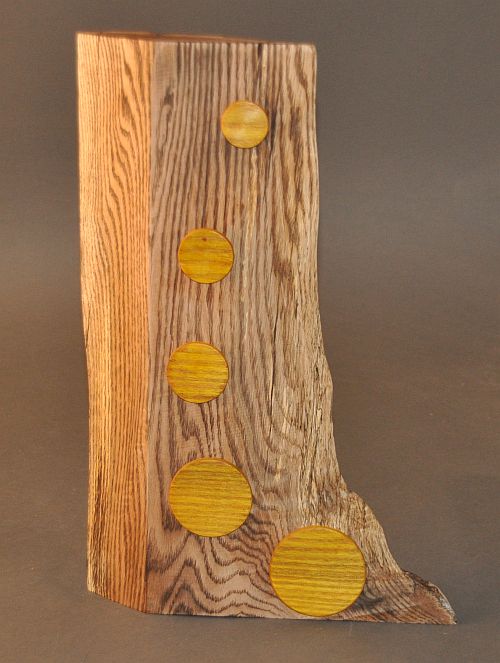
Suns of Time:2016 (15" X 10" X 3"). "Suns of Time" was made from sandblasted and ebonized Red Oak. The discs are dyed Red Oak. Price $175
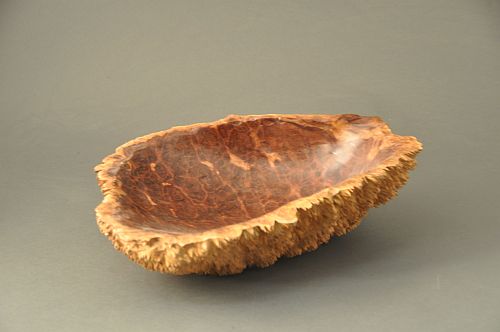
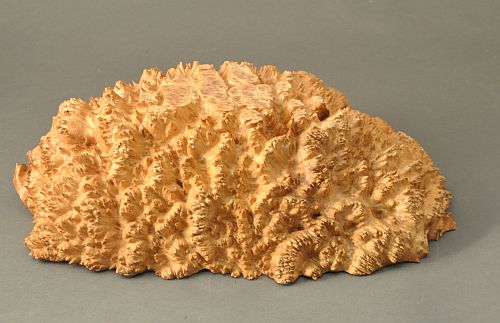 Red Morrel: 2016 (16" X 13" X 4.75"). Red Morrel is another Eucalyptus from Australia. As with Red Mallee, it produces exquisite burls. This one is stunning! I hand-carved the bowl to produce the incredible appearance. On the inside the burl feature shows prominently. On the outside, the surface has the characteristic "bumps" of a burl. The bottom is flat so it sits nicely on a table. I've had this piece at several shows and it is always the center of attention for my items. It is an incredible showpiece that will be the focus of attention in a room. Another truly stunning piece! Price: $450. (sold)
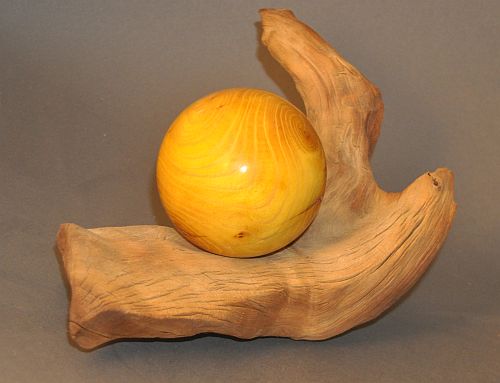 Bristleorange: 2015 (6" X 5" X 4"). Bristlecone Pine is one of the oldest living species of organisms that we have on earth, some of them being in excess of 5,000 years old. Some time ago I was at a woodturning show and a vendor there traded me some of the pine for a sculpture that I would make in trade. This is the sculpture, called "Bristleorange" which consists of a sphere made of Osage Orange from the Marie Antoinette Asylum region near Wyalusing, PA and a piece of Bristlecone Pine from Bone Mountain, Colorado. I chose the Osage Orange because it is a tree that is native to the Midwest and the French explorers in the late 1700's brought some of it to the Wyalusing PA. area and planted it on the Marie Antoinette Asylum area. I thought that the unusual aspect of the antiquity of the Bristlecone Pine and the history of the Osage Orange were intriguing.
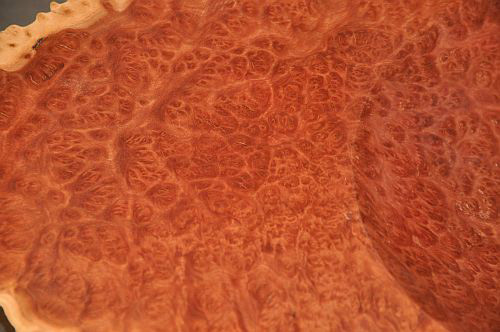
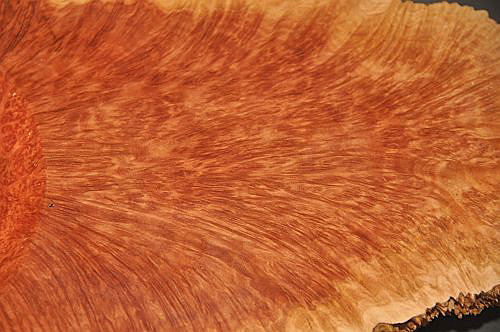
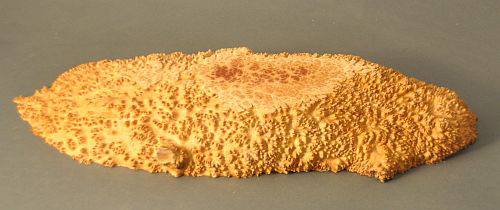
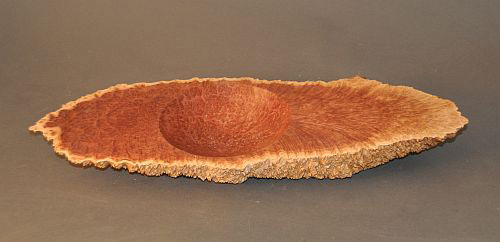 Red Mallee: 2015 (21" X 8" X 2"). is one of the Eucalyptus trees from Australia that is truly remarkable in appearance. While most Eucalyptus woods are visually very interesting, Red Mallee is stunning, especially the burls of this tree. I developed a method of turning the cut surface without physically attaching the wood onto the lathe so that the bottom of the piece doesn't have an attachment place typical of most turnings. This allowed me to leave the bumps of the burl intact for the visual interest. This turned vessel is unique both from the top and the bottom views. I turned a shallow (1.5" deep X 6.5" diameter) depression near the center of the piece. The flat to the left of the depression (2) has incredible burl feature while that on the right side (3) has amazing ray-features. The bottom side (Photo 4) is equally interesting. I created a slight flattened area on the bottom that allows the vessel to sit without rocking. This is a truly stunning piece! Price: $325 (SOLD)
| 2) Burl feature | 3) Ray features | 4) Bottom side |
 |
 |
 |
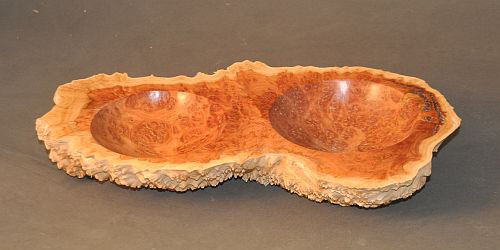
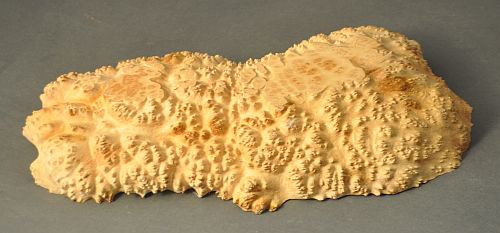 Red Mallee Double Vessel: 2015 (14" X 8" X 2.25 )
Another Red Mallee vessel. This one is equally stunning. The interesting aspect of this piece is that I developed a method of turning the piece that allowed me to exactly place the two depressions and, as with the previous one, not leave any chuck marks on the back. The two depressions are, respectively, 5" diameter by 1.5" deep and 4.5" diameter by 1.25" deep. Again the bottom was flattened to allow the piece to rest without rocking. As with the previous one, the bumps associated with the burl figure are preserved intact. Price $375 (SOLD)
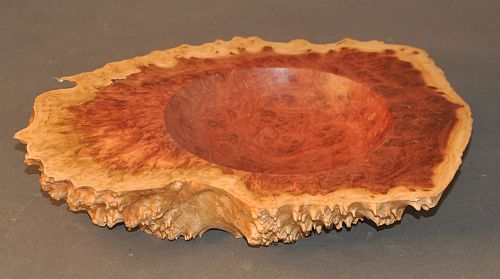 Red Mallee Single Vessel: 2015.
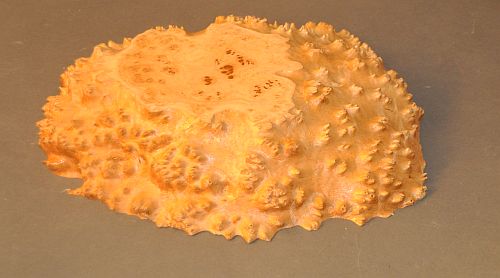 (12.5" X10" X 2.25"). This is another example of the incredible appearance of Red Mallee. This one also has a flat bottom to prevent rocking. Like the others, it shows the incredible character of the outside of the burl. Another stunning piece! Price: $300 (SOLD).
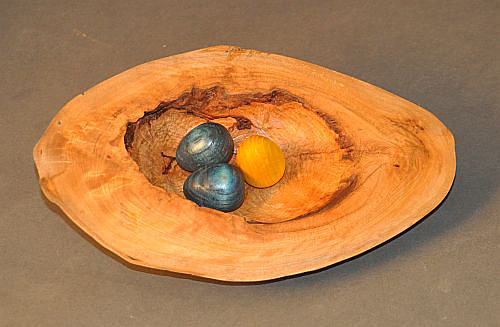 Cuckoo: 2015 (9.25" X 6" X 2.7" ). This vessel was carved from a piece of a Sugar Maple tree where a limb broke off and the tree healed itself. This piece was sawn off by a sawyer and left in the woods for me to find. I carved out the inside and sandblasted both the inside and outside to give it the "nest-like" appearance. The three wooden eggs were turned from White Ash and dyed and then glued in place with epoxy. The two blue eggs represent the eggs of the nest builder while the yellow one is the egg of a Cuckoo, which is a nest parasite. The bright colors of the eggs highlight this piece. Price $200.
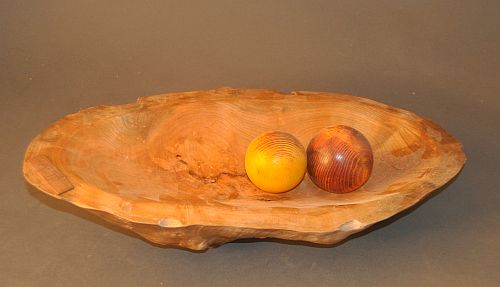 Buddies: 2015 (19" X 10" X 5"). I hand-carved the depression in this vessel. Note that a crack developed in the far-left edge so, I put my trademark walnut bandage over it! The spheres were both stained to achieve the stunning colors. The name was derived from watching my two cats which are brother and sister. They are frequently nestled together as these spheres are. This is an interesting piece that never fails to gather comments! Price $250.
"AINTS" I've always been intrigued by insects (I almost became a professional Entomologist when I went to graduate school). Ants are of particular interest because of my entomological background and the fact that they tunnel in and alter wood-- the medium with which I work. Recently I came across cast iron black ants that fit into what I was doing with wood. I call the resultant sculptures "Aints" from how I heard the word pronounced while down in the hills of the Carolinas. Here is a series of "Aints" and wood that I have crafted. Enjoy!
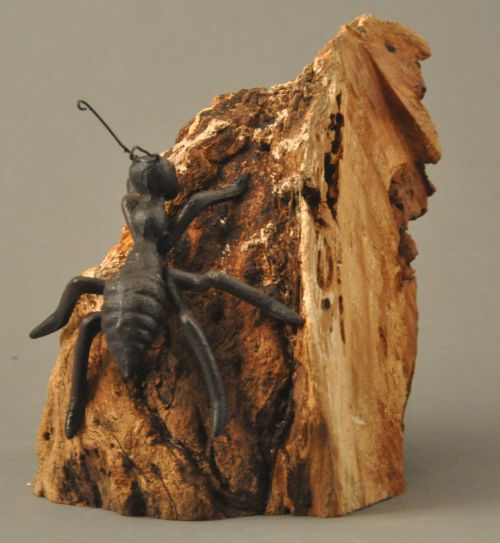 Aints:2014 (9.75" X 7.5"). This whimsical sculpture consists of an interesting piece of Pennsylvania Black Cherry that had real-life black ants tunnel in it. The one that is now eyeing the piece is made of metal but it is just as formidable a critter as the real-life ones that worked over the piece. The wood is sand blasted and sprayed with acrylic to preserve it. The cut side is rough as when it came off the chain saw in the woods. ($75)
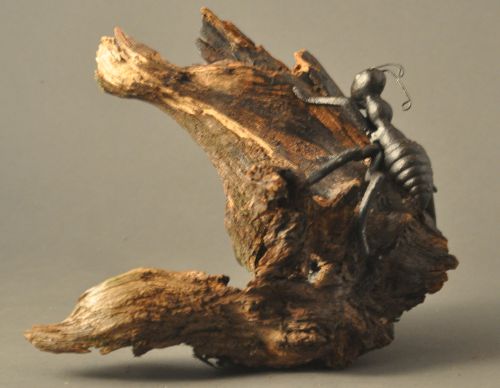 Aints Too: 2014 (10" X 8"). This little lady is crawling up a piece of Black Locust checking out what is available for her to eat! The stump she is on is from a Black Locust tree in my sugar bush that was cut down many years ago and mostly rotted away. I was able to sand blast the stump and impregnate it with shellac and polyurethane in order to stabilize it. It is very delicate so needs careful handling! ($125)
 Aints Two Too: 2014 (32" X 10"). Another larger piece of Black Locust was used for this interesting piece. The two ants are searching the piece to find goodies. Again, the piece was sand blasted and stabilized with shellac and polyurethane. This one is not quite so delicate but still needs careful handling. ($135).
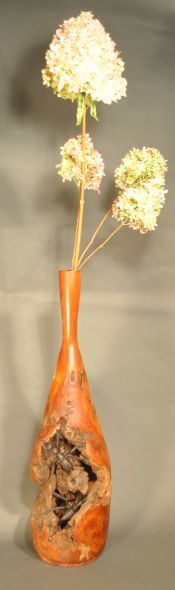
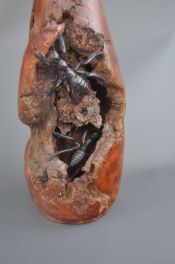 Aints On Cherry Vase: 2014 (9" X 31"). This piece is from a very large limb burl on a Black Cherry tree. Again, ants had gotten into the heart of the tree and removed much of it. I turned this piece on the lathe, sanded and finished it and then drilled a hole in the top so it could be used as a dry flower vase. It is shown with dry Hydrangia flowers but many other dry plants, including interesting tree branches could be displayed in it. A closeup of the piece is at the right. The two black ants set this piece off as a very unusual find! ($325)
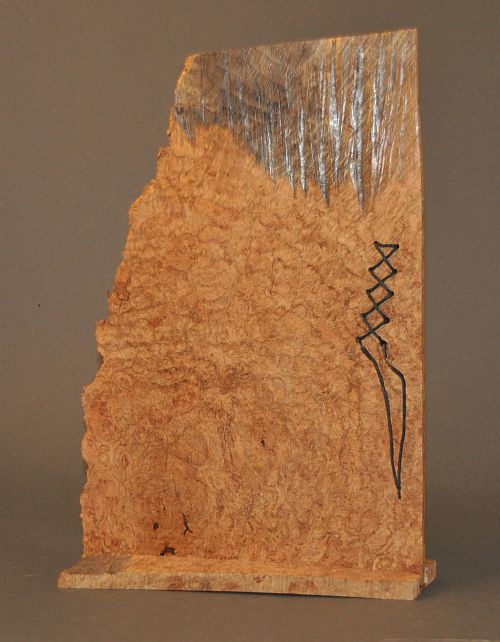
Burl-in Wall: 2013 (9.25" X 13.5). As I composed this piece, I was considering the effect that John Fitzgerald Kennedy had on our country as we approached the 50th anniversary of his untimely death. When JFK gave his famous speech at the Berlin Wall in Germany in 1963 he expressed hope that the free world and communism could somehow come to terms with each other and people could live free. My piece has the name “Burl-in Wall” , an obvious play on words, from the Red Oak burl and its wall-like appearance and my remembrance of this divider of the free and communist worlds. The stitches are the thread of hope longed for by JFK. $175
KIA ORA
"Kia Ora" is a New Zealand Maori greeting that means "be well" or "be healthy" or simply "hi". It is said as a greeting or in parting. Val and I spent a few weeks in New Zealand in February and March of 2011 on a tandem bicycle trip. I've attached a file copy of an article that was written about our trip by David Keeler of the Rocket Courier in Wyalusing, PA.
While in New Zealand, I was impressed with many of the cultural aspects, particularly the fact that the Maori are a revered group of natives. I came up with my artistic concept of the "Kia Ora" when I got back home. This idea subsequently developed into several expressions. The name was inspired from communications with two wonderful people, Catherine Brimecombe and her daughter, Iona, whom we met in the Tussock Grasses region near Te Anau, NZ.
A Kia Ora will make an excellent unique housewarming gift for that special person. Displayed in a prominent place in the home, it welcomes visitors with a traditional Maori greeting! I have several different types with a range in prices starting at $50. Contact me for details!
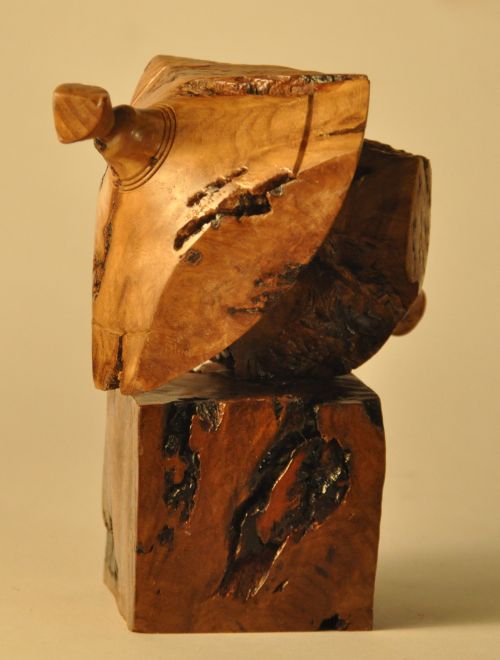 TASMANIAN EUCALYPTUS KIA ORA: 2011 (5" x 6.5"). While at a recent woodturning convention, I met a wood dealer from Tasmania. He had a wide variety of interesting woods for sale, including this spectacular Gum Vein Eucalyptus. The wood of itself is stunning. It is a natural for a Kia Ora!
$250 (Sold)
 BLACK WALNUT KIA ORA: 2011 (5" X 6.5"). This Kia Ora shows the spectacular aspect of Black Walnut at its finest. The top has a unique "button" in the front (see photo). The bottom is interesting in that there is a bark inclusion that makes it very handsome.
$195 (Sold)
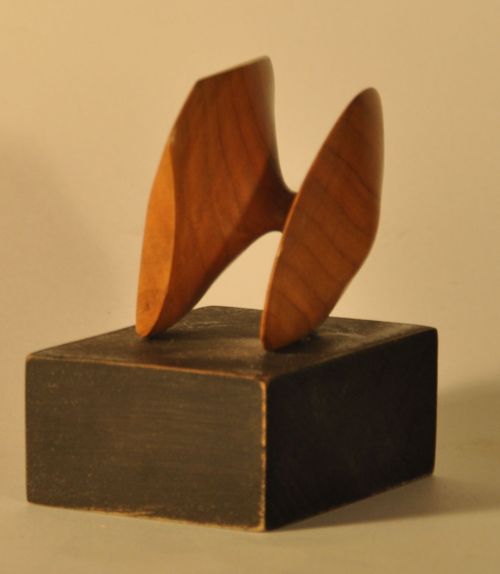 BLACK CHERRY KIA ORA: 2011 (3.75" x 4.75"). This Kia Ora is photographed in side view to show how the two parts of the top are related to each other. Note from comparing this to the others that the back part is rotated approximately 1/4 turn from the top part to make the unique shape of the Kia Ora. The top of this Kia Ora is Black Cherry that has been left its natural color. The base is also Black Cherry, however, it has been flame ebonized and then lightly sanded to relieve the corners and let the natural cherry color show through.
($85)
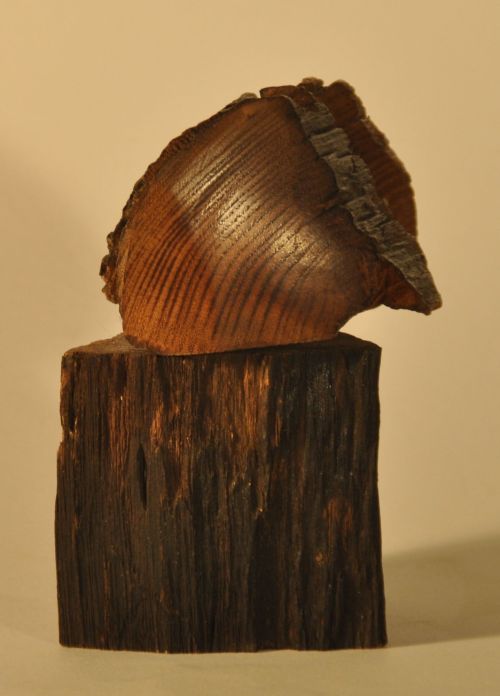 BLACK LOCUST KIA ORA:2011 (4.75" x 5.75"). This Black Locust Kia Ora was created from the Black Locust fence posts that were left on my property by the previous farmers. These posts are heavily weathered but, being Black Locust, they resisted the weathering and developed an interesting weathered surface. I left the blackened, weathered surface on most of the post. The only surface preparation I did on the post was to wire brush off the loose material. This one has a buffed polyurethane surface.
$145 (Sold)
PUNAKAIKI, NEW ZEALAND AND THE PANCAKE ROCKS
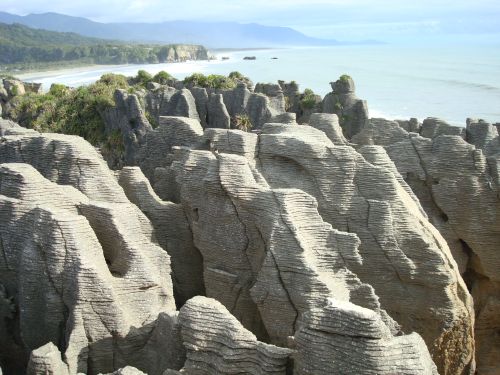 PANCAKE ROCKS: Traveling along the northwest coast of the South Island of New Zealand between Westport and Greymouth, the bicyclist is treated with spectacular views of stratified limestone rocks that previously formed the sea floor of the Tasman Sea. The sea floor was pushed up during a long-ago orogeny and the rocks have since weathered into interesting, unique patterns. The Punakaiki, below, is my expression of these rocks.
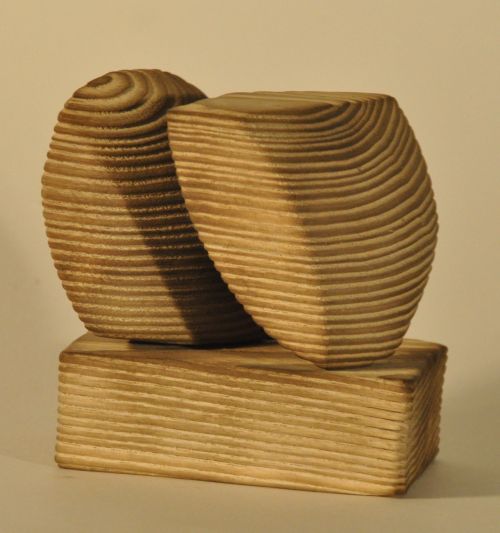 PUNAKAIKI: 2011 (3.75" x 4.75"). This sculpture is made from White Ash on my property here in Camptown, PA. White ash is perfect for imitating the stratification of the Pancake Rocks of Punakaiki, NZ. in that the early wood is soft and the late wood hard so it is easy to "weather". I turned a typical Kia Ora out of White Ash and "weathered" it by flame ebonizing and sandblasting. The appearance is amazingly similar to the rocks at Punakaiki.
($95)
BOWLS and WALL HANGINGS
When someone mentions a wood lathe, the first association is bowls. While traditional bowls are frequently turned with a lathe, an unlimited number of variants of the traditional bowl are possible. While I turn my share of traditional bowls, I can't pass up the chance to work with odd-shaped or badly damaged wood pieces that allow me to turn one-of-a-kind objects. Also, I take advantage of mistakes or flaws in the wood to create some unique, interesting pieces. Wall hangings are really flat bowls that are displayed like a picture on the wall.
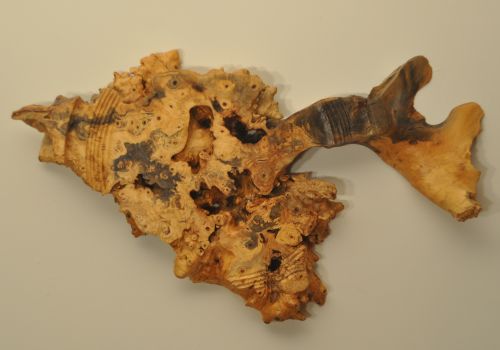
Trish: 2013 (25" X 13"). This wall hanging is turned from a beautiful piece of California Buckeye Burl. The piece was turned on the lathe and minimal relief was produced (note the concentric ridges around the perimeter of the piece). I have several hanging points in the back of the piece so it can be hung in a number of positions. As shown, it is a fish. If rotated a quarter turn clockwise it becomes a tree, thus, the name “Trish” for Tree Fish. The name came from my friend, Trish, in Australia. At any rate, it is a very interesting wall hanging that elicits many comments. ($400) sold
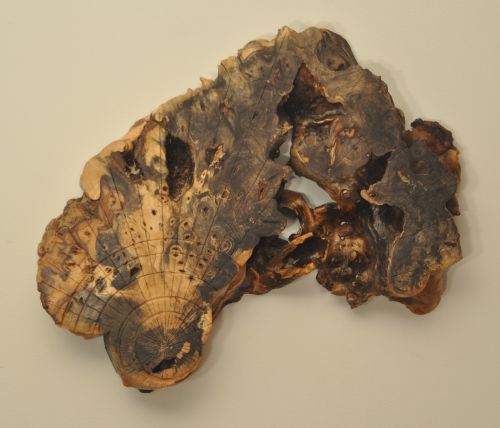
King Leo: 2013 (17" X 12").. This is another piece of California Buckeye Burl. As with “Trish”, the piece was going to be scrapped as the person who had the rough wood saw no value in them. Again I did minimal turning but I carved a “sunburst” pattern for interest. It got its name from my seeing a lion head looking to the left (it helps if you drink a bit of wine prior to looking at it!). ($400). sold
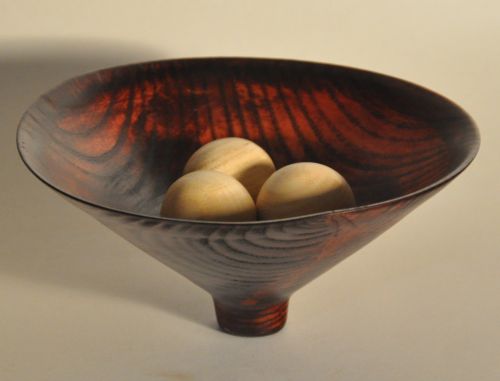 Four Ash Eggs: 2011 (6.75" X 3") is a small White Ash vessel with 4 small spheres (3 are 1.25" diameter and one is 1" diameter). The vessel was turned and then died blood red. I came up with an interesting technique that allows me to modify the penetration of the dye so the surface has light and dark blood-red areas. This is a delicate vessel with very thin walls. The "eggs" are really spheres. The smallest egg rests in a hollow in the bottom of the vessel and is not visible in the photos. $250 (Sold)
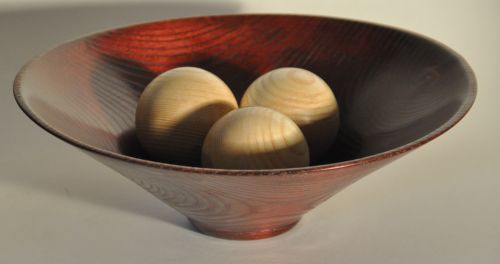 Ash Elegance in Red: 2011 (9.75" X 3.25") is a continuation of my experimentation with coloring wood. White Ash lends itself to an incredible array of color/texture changes so I am focusing on it. This piece was turned and then dyed blood red. It also has a hint of liming wax that I applied after the dye. The three ash spheres (2.5" diameter) were left natural. $250 (Sold)
 Ash Elegance in Blue and Red: 2011 (8.75" X 4.25") is another White Ash vessel. This one has multiple coats of color including blood red, cherry and blue. The stains were layered sequentially so that all three show through. Again, I included the triple spheres of natural White Ash as a focal point. This is truly a stunning vessel! $250 (Sold)
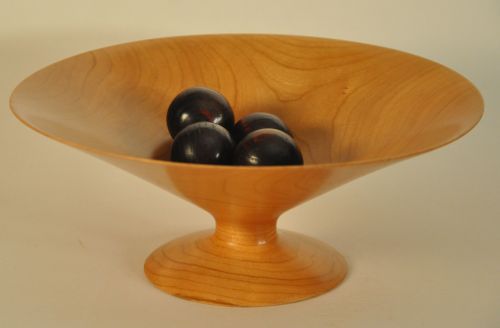 Cherry Vessel with Spheres: 2011 (8.75" X 3.5") is an interesting very delicate Pennsylvania Black Cherry vessel with four dyed White Ash spheres. The four White Ash spheres are approximately 1.25" in diameter and dyed blood red. I flame ebonized the spheres prior to staining them and the resulting color is quite interesting. They are highly polished so they look like they are marbles rather than wood. $250 (Sold)
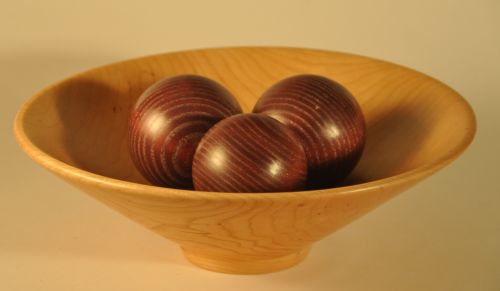 Wendy's Bowl: 2011 (10" X 4.5") was made as a housewarming gift for our Wyalusing friends, the Gaustads. The bowl itself is made from Pennsylvania Black Cherry and shows the nature of the wood. Cherry is photochemically sensitive and, over a period of time, will darken. The photo of this bowl was taken immediately after I turned the bowl so it hasn't darkened yet. The three White Ash spheres in the bowl were dyed and limed to bring out the beautiful grain of White Ash and add an interesting focal point to this piece.
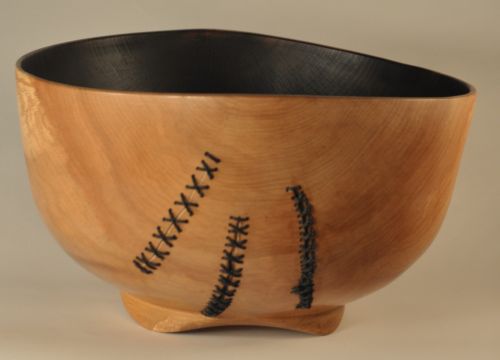
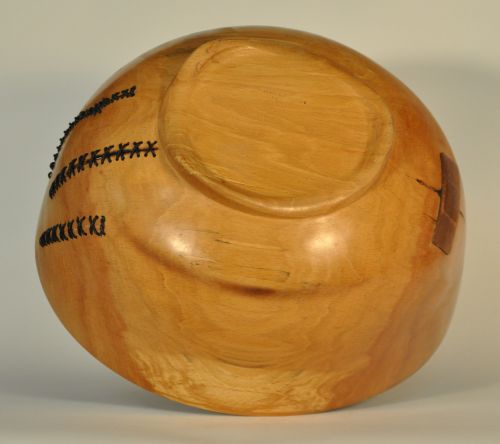
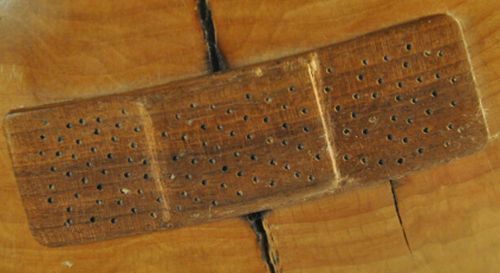
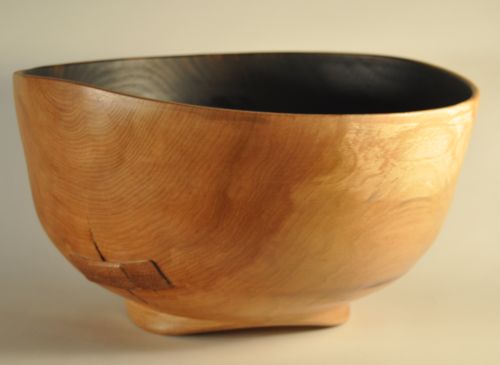 Stitch-Em-Up: 2010 (13" X 7") is an interesting vessel turned from American Beech. The view to the left shows the bandage; to the right is the other side with the stitches. I was playing with this piece and, after it was finish-turned, stress cracks developed in various places as it quickly dried. Normally this piece would have wound up helping me heat my shop but I needed a piece to work on some ebonizing techniques that I’m trying so I flame-ebonized it. As expected, the piece cracked badly when I torched it but, after cooling down, most of the small cracks closed over. I became intrigued with the appearance of the piece at this time because now it was shaped like a half of a watermelon rind and had some nice cracks. After flame ebonizing, I stained the inside uniformly black to give it a rich uniform black appearance. I then stitched up one side using leather stitching. The other side called for something unique. It was “wounded” so, obviously, you put a “bandage” on a wound to heal it! The bandage is carved walnut complete with raised pad and small holes (see below right). Also shown below on the lower left is a bottom view showing the turned, carved foot. ($650).
 Hollow Spalted Sugar Maple Vessel: 2010 (9.5" X 3.5") This vessel was turned from a huge Sugar Maple tree that died in our front yard. Note that part of it is highly figured (spalted) from fungus that invaded the tree while it was dying. The vessel is hollow with approximately 3/16" thick walls. ($400).
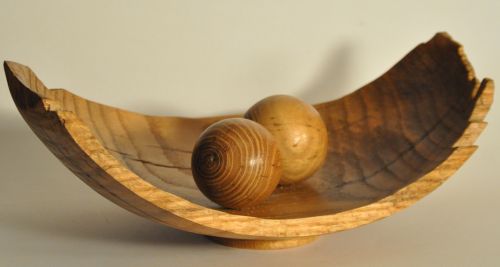 I'm Ready to Retire:2007 (12.5" X 4.5") is from a very old piece of Red Oak that was being discarded at the university where I worked. It was heavily split so was very difficult to turn without it breaking. I had to tape it during turning to keep it together. It, like me, had served the university a number of years and we were both ready to retire. I recently added my signature spheres to the vessel to give it more pizzazz! ($550).
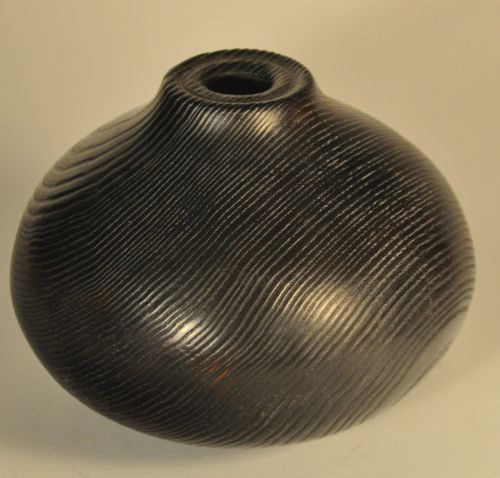 Ebonized Ash Hollow Vessel: 2009 (6" X 5.75") Ash has a very distinctive grain, especially after it is flame ebonized. The interesting changes in shape that occur with the flame ebonizing only add to the appearance of this vessel. ($250)
 Wired: 2008 (17.5" X 5.5"). This interesting vessel was turned from a large Black Walnut log that grew in an urban setting. As with most urban trees, there is hardware in this one. I didn’t find it until I was nearly done with the turning but, there embedded deep in the bottom is a piece of iron fence from long ago (thus giving this piece its name). The knot on the rim plus the embedded iron lends a beauty to this piece. The rim is undercut and the outside of the bowl tapers gracefully to the foot. This masterpiece includes 7 approximately 2” diameter spheres of various hardwoods that complement the appearance of the turning. ($850- includes 7 spheres).
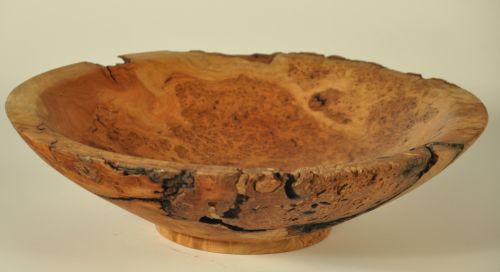 Beauty: 2010 (14" X 3.5") is a very fragile Black Cherry burl that incorporates a portion of the bark, spalting, and burl all in one. To add interest is the fact that insects laid eggs in holes in the wood and packed fine mud over the eggs to protect them. The dried mud is still intact in the piece (the insects are long gone!). This is a priceless, one-of-a-kind piece! ($650).
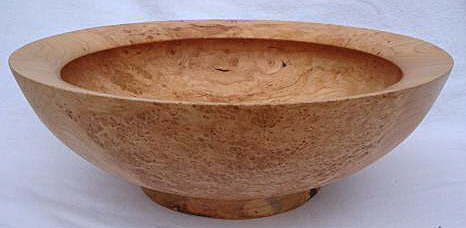 Sherry's Bowl: 2010 (13" X 4.25") was made for a very special couple, Devin and Sherry when they were married. It is turned from a beautiful piece of Black Cherry burl. The bowl was turned thin with an undercut lip and is on a raised foot. It now resides in their home.
 Cherry Bowl With A Wide Rim: 2010 (9.5" X 2.5") looks a bit like Sherry's Bowl except on this one I rounded the bottom so that the bowl actually rocks when lightly touched. ($175)
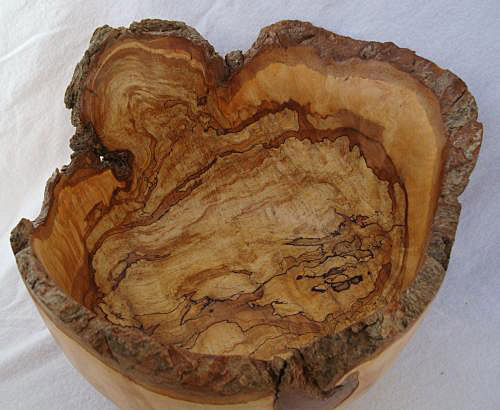
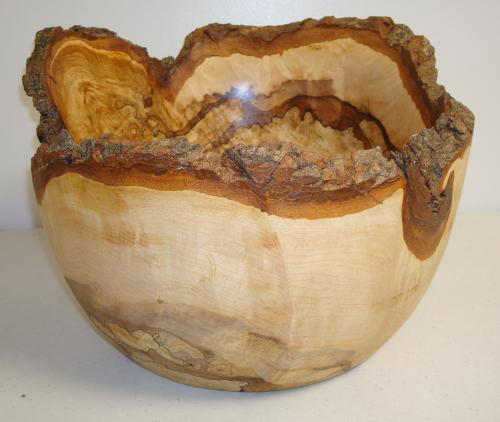 Yoder Maple Bowl: 2009 (11.5" X 9") is a special piece to me. It comes from a 15 foot circumference Sugar Maple tree on the Daniel Yoder farm, an Amish farm in Bradford County, PA.. A sugar maple tree of this size would be well in excess of 400 years old. To put this age in perspective, the Mayflower landed at Cape Cod in 1620- this tree was probably a seedling then! Unfortunately the tree was hollow so it was impossible to count growth rings and get an accurate age. The tree was dying and Mr. Yoder cut it down to prevent accidents from falling limbs. The tree yielded literally tons of highly spalted, curly maple. The Yoder Maple Bowl represents a natural-edged piece from the trunk of the tree. ($850)
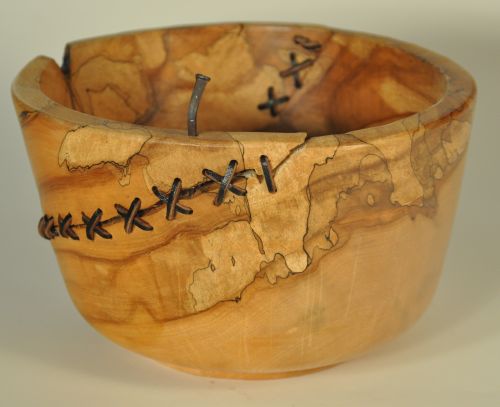 If It's Broke, Fix It: 2009 (10.5' X 6") This piece is turned from a badly decaying American Beech log. This wood was loaded with water and would almost immediately split upon turning it. It was very difficult to work because much of it was very hard and the rest was punky. When I got it off the lathe, a large split immediately developed in the side. I nearly pitched it but, upon reflection, decided that it needed fixing.The cracks were laced together with leather and, to add a focal point, an ancient cut nail from my 100+ year old house was driven into the rim and bent over. This piece spurred development of the idea to use lacing in my turnings. ($400)
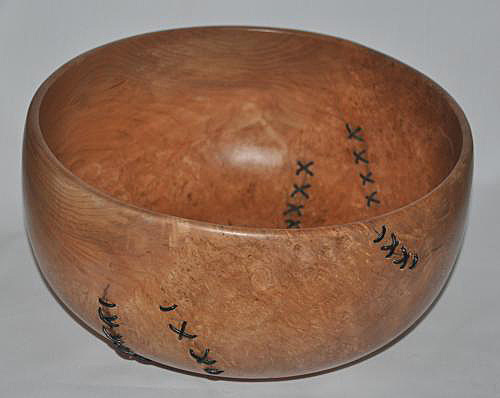 Frank: 2009 (12.5" X 6") After turning "If It's Broke, Fix It", I turned a Black Cherry burl that was intact except for some natural cracks in the wood. The cracks were another perfect opportunity for lacing. This piece became "Frank" because it reminded me of the stitched-up Frankenstein's Monster and it has become one of my favorites. $750 (Sold).
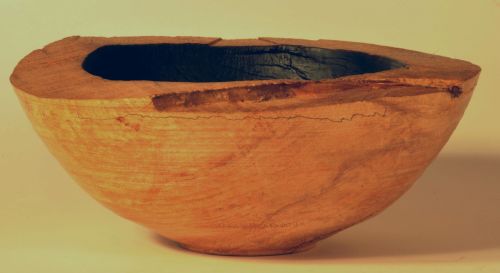 Holey Grail: 2010 (9" X 3.5") is an interesting piece that incorporates a lot of the items that I like in my work. First, it is rough. The rim is the natural chain-saw edge, the outer walls are rough-turned, and there are holes in the vessel. Secondly, I was able to successfully ebonize this piece by first charring it with a MAPP gas torch and then staining it with black water-based stain. The name is derived from the fact that the inside of the vessel has many small holes in it and, a grail is sometimes a vessel. (More importantly, I'm a fan of Indiana Jones). ($155)
SPHERES
 One of my very favorite objects to turn is a sphere. I guess that I got into doing them because everyone told me that they are so difficult to turn. Now, I agree that if I were told to turn a bearing for the Timken Ball Bearings Company I'd shudder since I could never approach the accuracy that they need for these. My spheres aren't perfect, however, neither are the ones made by Timken. They all deviate at least a few thousands or millionths of an inch. Mine vary a bit more but, who's looking? I can turn these in just a few minutes without making any measurements or spend more time with calipers and jigs to get them more uniform in size. My preference is to do the former, not the latter! Read about how I do it in my article "Spherical Thinking".
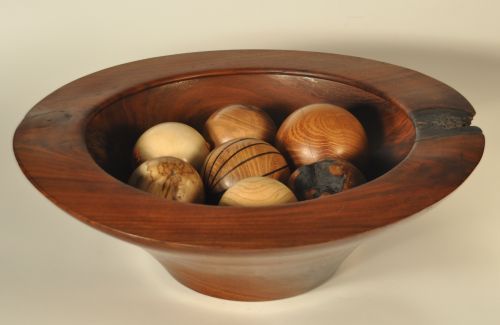
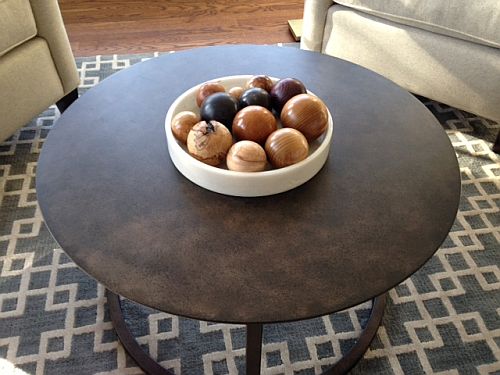 I'll work with you to create a group of spheres that work with bowls, etc. that you already have. I recently completed this assemblage of spheres for a client who had an interesting white bowl she wanted to fill with wooden spheres. Let me know what you are looking to produce and I'll work with you to create an interesting grouping such as shown here.
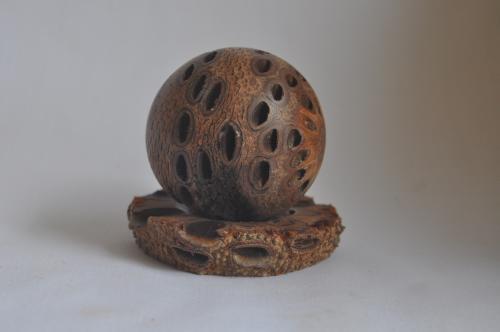 Banksia Seed Pod Sphere on Base: 2015 (sphere approximately 3" diameter). The Banksia Tree of South West Australia produces a huge (1 foot long or longer by 2 to 4" diameter) seed pod that would remind you of a pinecone. They aren't even distantly related to pines and the cone they produce looks far different upon close inspection. The Banksia pod has its seeds in the oval holes visible in the photo at the left. Also, they have some interesting red-velvet-like fuzz around the seeds. At any rate, I purchase the pods from a supplier and make the spheres from the pod. They make a very interesting desk ornament. I have several of these available, so, if you are interested, contact me. They range in price from $50 on up depending on their size and appearance.
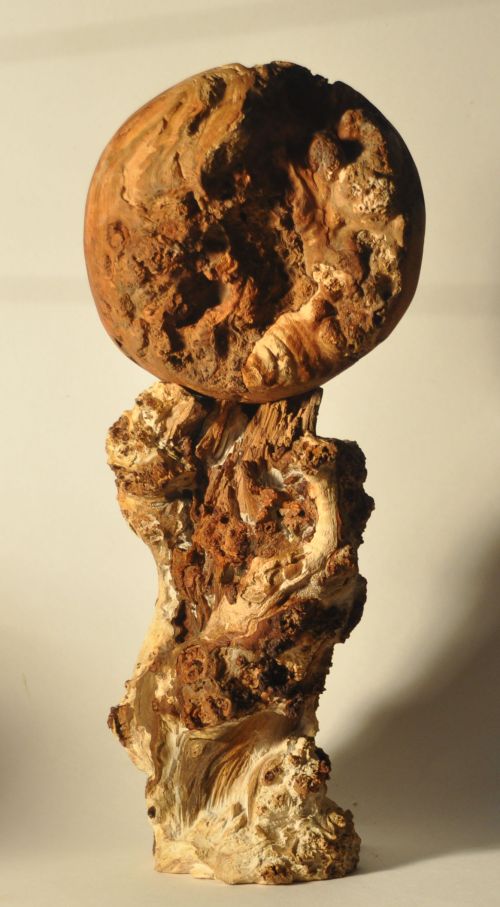
Lunar Memories: 2011 (5.5" X12.75") is a compilation of two pieces of heavily decayed, spaulted Black Cherry burl. The two pieces were part of one limb burl. Note the deep crevasses and heavy spaulting in the piece. The sphere is approximately 5.5" across and had a significant amount of decay that had to be removed. The bark was still on this section when I turned it and I removed it all to reveal the underlying dormant limb buds. The punky part of the piece was removed by hand-carving and then sand blasting. Up close the piece is spectacular in that it shows the growth rings of the tree with the softer early wood having been blasted away and the late wood remaining proud. It is finished with a low gloss acrylic to maintain the mystical aspect of it being the lunar surface. This is a truly unique piece! $350 (sold)
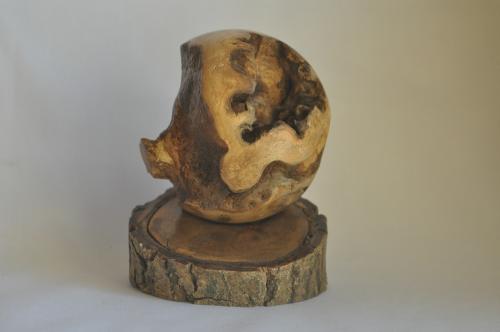 Fred's World Without Water: 2010 (4" X 5") This is a piece of Black Gum that had Mistletoe attached to it. I found the wood on a tree in the Oriental, North Carolina area. It is mounted on a piece of Cottonwood from Virginia. Turning this sphere was a challenge as much of the piece was eroded away by the effects of the Mistletoe. It reminded me of what our globe would look like if there was no water on earth. This one appears in my latest article "Spherical Thinking" in the American Woodturner journal. ($175).
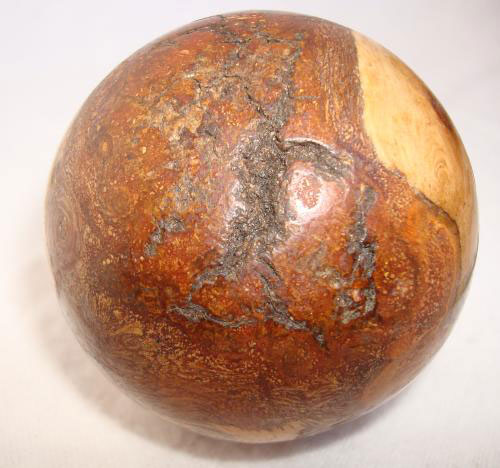
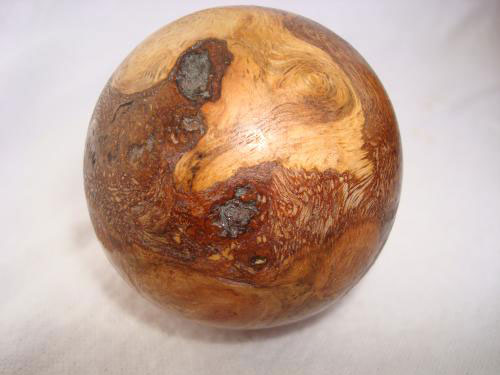 Planet X: 2009. (2.5" sphere). Rough wood with lots of character is one of the most interesting to work into spheres. My east side and west side of "Planet X" (two sides of the same spheroid) show this unique aspect of cherry burls. (Not for sale)
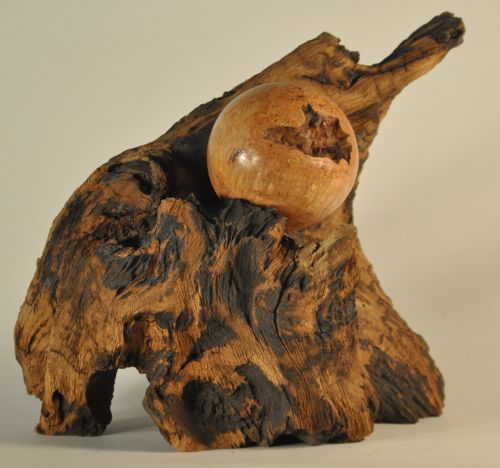 Watchful :2010 (8.5"X8"). Spheres add a great deal of interest to rather mundane objects. The base of this sculpture is a highly weathered Black Locust stump that I've wire-brushed and finished. The sphere is spalted Black Cherry and has an area where the bark intruded into the piece and I removed it. The two make a beautiful pair! ($95).
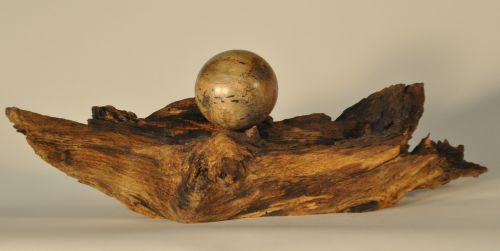 Out On A Limb: 2010 (15.5"x5.5"). The sphere in this composition is from a piece of spalted, Powder-Post Beetle tunneled Sugar Maple. The Powder-Post Beetles made significant tunnels throughout the piece and that, along with the fungal spalting created an interesting sphere. I slightly stained the sphere prior to finishing it to add another level of interest. The limb, again, is a wire-brushed Black Locust piece. ($55)
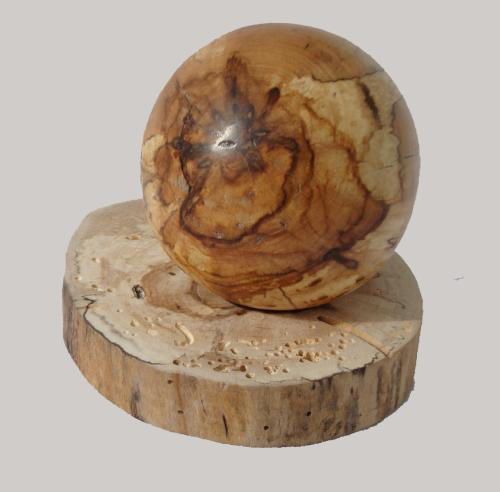 Creativity Ball. (This one is approximately 2.5" sphere on a wooden base). I got the idea for my Creativity Balls while watching people who are under stress. They need something in their hands to work. The Creativity Ball is the perfect size to hold and roll in the hand. This one is turned from heavily spaulted Sugar Maple limb that has lots of Powder Post Beetle holes. The base is turned from another piece of the same tree. There is a slight depression turned into the surface of the base to help hold the ball when it is not being used for "therapy". I make a wide variety of these out of a number of woods. Size and wood type can vary to suit your specifications. Please contact me with your specifications and I can quote you a price.
TALL THIN SPINDLES
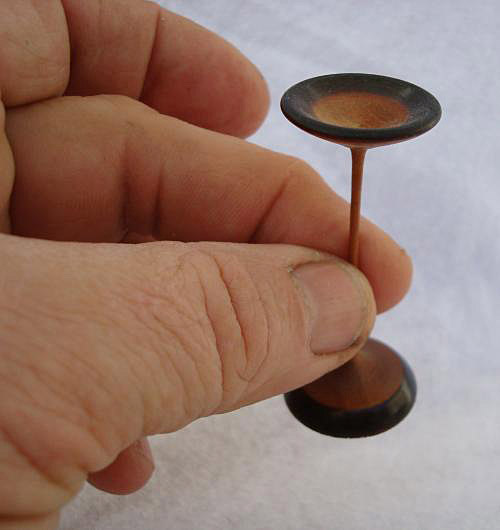 Tall, thin spindles create a unique challenge for woodturners however I have figured out a way to turn them very easily. I am able to turn stems that are 1mm in diameter and 3 to 5 inches long with discs at each end. I am presently turning spindles that are up to 12" long and approximately 3/32" in diameter. When turned properly they can add a stunning effect to a composition. They can be used in a number of interesting arrangements.
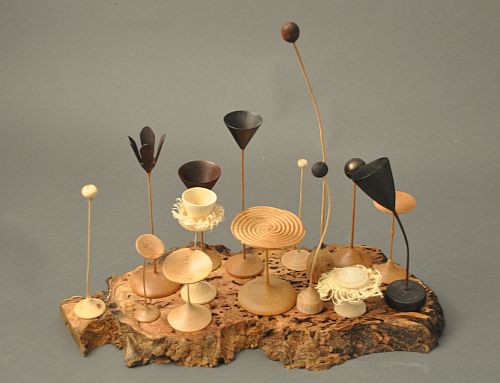 A Forest From The Trees: 2013 (13 ½” X 7 ½” X 11”). This sculpture consists of 15 tall, thin spindles on a section of Eucalyptus Gum Vein Burl. The thin spindles vary in height from 1 ¾” to 10” and are not attached to the base so they can be arranged in any pattern. Each of the spindles is turned from a single piece of wood-- no glue involved! The Eucalyptus Gum Vein Burl is from a Tasmanian tree.
The thin spindles present a challenge to the woodturner in that they are easily broken while being turned because they are so thin. The spindles are from 1/16” to 3/32” in diameter. Some of them have a knob at the end, some have a cone, some a simple flower and some are dyed.
This piece received critical praise by Michael Hosaluk and Ray Key in the Instant Gallery critique at the Ohio Valley Woodturners Guild Symposium in October of 2013. ($1200)
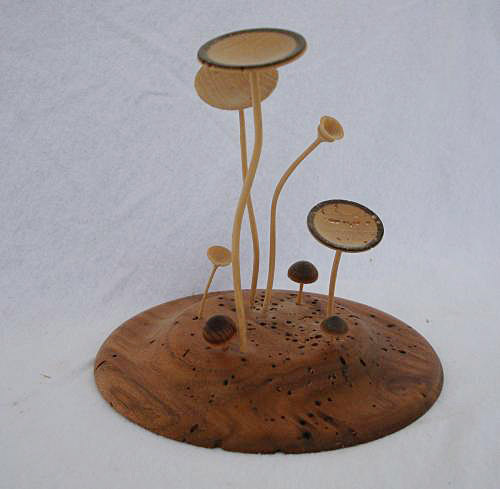 Someday I'll Finish This Piece: 2008 (6" X 6") All of us have an unfinished piece like this laying around awaiting our attention. This one has been sitting around unfinished for so long that powder post beetles have riddled the butternut and mushrooms (lathe-turned, of course!) have sprung from its surface. This piece has a Butternut base with Red Oak fungi. Both the Butternut and the R Oak are riddled with Powder Post Beatle holes. Some of the mushrooms were fire-ebonized during the turning process. ($350). Sold
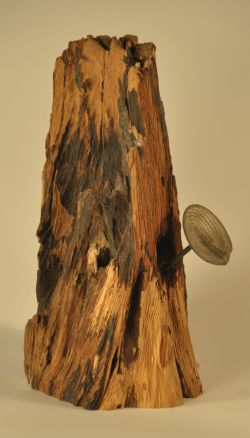 Mushroom on Brushed Black Locust Fence Post: 2010 (5.25" X 7"). This mushroom was turned and dye-ebonized to give it an appearance of having originated from the fence post. The section of fence post was badly weathered so I had to wire brush it to remove the loose material. I make a number of these sculptures and they are all unique. ($45) SOLD
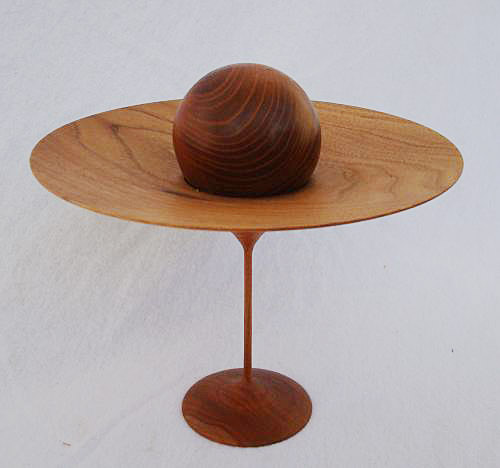 Flying Saucer: 2002 (6.75" X 5") shows what to do with a piece that starts off with promise (the disk) but has a "problem" (It broke while I was turning it). When the disk broke I decided to further perforate it and add the sphere and pedestal to form an interesting composition. This is another of my sculptures that are featured in my American Woodturner article, "Whoops---Wow". ($225)
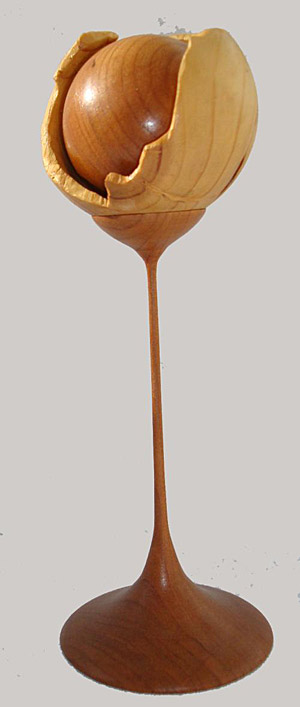 Inner Space: 2002 (2.25" X 7") was a fun project that started from a mini disaster. I was turning a small hollow sphere when I blew out a large hole in the surface. After initially discarding the hollow form, on second thought, I gave it a second life by inserting a small solid cherry sphere and then turning a tall thin pedestal on which it would rest. It and "Flying Saucer" became very interesting pieces after near disasters and spurred me to write an article for American Woodturner entitled "Whoops--- Wow" (Summer 2002) in which I discussed the issue of reworking objects when problems occur. (Not for sale).
ETCETERA
Cro Magnon is one of my favorite sculptures. It is from the root of a dead Ash-Leafed Maple (Box Elder) that grew and died along the path up to my pond. When I found it I immediately saw that I could carve out the interior and polish the piece to form a very unique piece that varied depending on your view of the piece. It got its name from the outside view since the two depressions looked like eye sockets and gave the impression of a human skull. From the inside it either looks like a breaking wave or an interesting hollow-form. The natural red stain characteristic of the wood is visible.
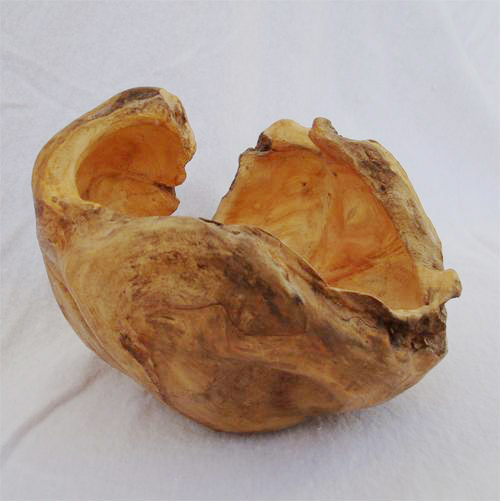
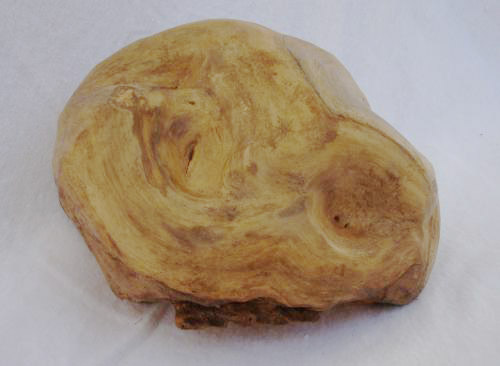
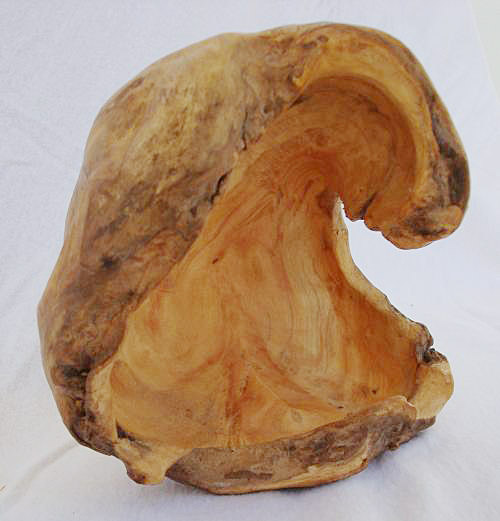
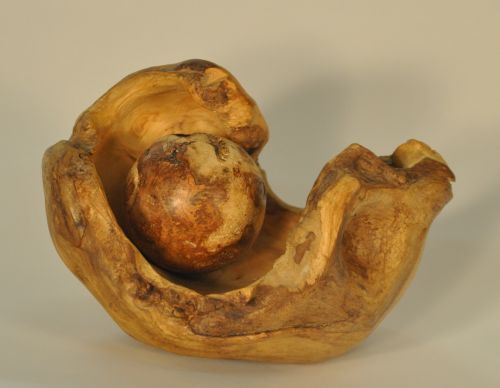 Cro-Magnon With Sphere: 2010 (8" X 5") is the same composition as above except I have attached a matched sphere that highlights the piece. This is the final modification on this interesting piece. It appeared in another iteration in my article "Spherical Thinking". ($225)
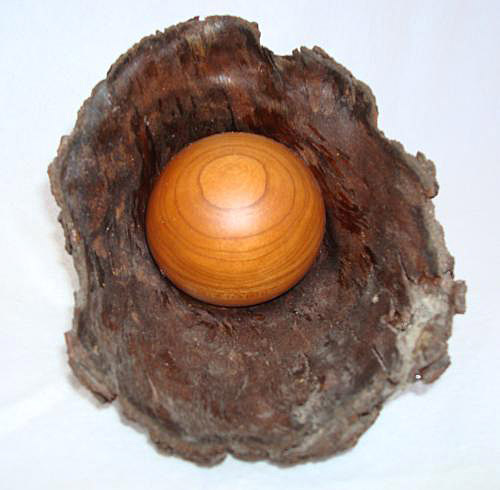 Safe At Home: 2008 (4.5" X 4") This composition is created from a bark piece that was carved hollow and then the sphere attached. It gives me the impression of a gnome hiding in his cave waiting to come out when the rain goes away. It appeared in my publication "Spherical Thinking". (Not for sale).
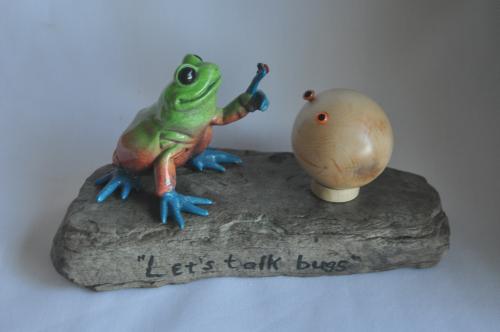 Let's Talk Bugs: 2010 (10" X 5") is obviously a whimsical piece that incorporates a sphere, a ceramic frog, and a stone base. The sphere is the one that I turned in demonstrating how to make spheres in my American Woodturner article "Spherical Thinking". It appears alone in the bottom right of the last page of that article. The wood I used was a piece of fresh Quaking Aspen from my woodpile. When I was done turning the sphere, I dried it in a microwave oven (to the point that it was smoking!). It ovalized and cracked along the side because the pith was near the edge and that more narrow portion of the sphere pulled apart creating the crack. When it was completely dry I sanded the crack smooth to create the mouth. The eyes are taxidermist's pigeon eyes that I purchased over 55 years ago when I thought that I might become a taxidermist (I didn't). I've had them in a box for all of these years and just now discovered where they would be used (NEVER throw anything away!). The frog is "Freda" from Kitty's Critters. (Not for sale).
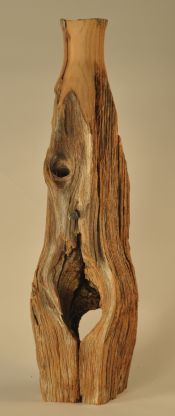 Locust Fence Post Weed Pot: 2010 (3" X 13"). I have an old farm that originally had cattle fences to keep cows in pastures. The posts were made from the abundant Black Locust trees that grew on the property. These trees were all split into triangular posts. Locust fence posts are notorious for lasting decades in the ground. The ones on my property may have been in place for many decades prior to my "rescuing" them. An aspect of the locust, besides its durability, is that there is usually a small amount of punky wood on the outside and this can be wire brushed off and the underlying wood is incredibly interesting in appearance. This post literally fell apart when I cut it so I drilled holes and put cut nails from my century-old house in it to hold it together. The top is turned and drilled so it will hold dry weeds for a display. This particular one is interesting in that a limb grew from the side near the bottom of this piece and completely deteriorated many years ago, leaving a neat hole in the wood. This one is ($155). I make a wide range of these for prices that start at $30.
OTHER INTERESTING PIECES
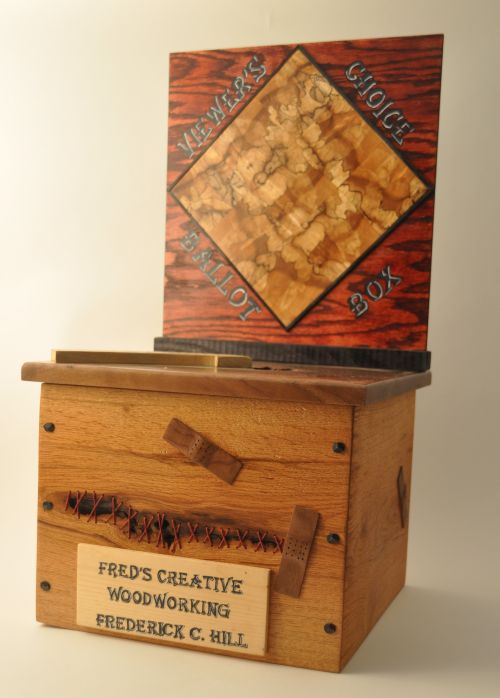 Viewer's Choice Ballot Box:2012 (11.5" X 11.5" X 23.25" including sign). For years, Machine Quilters Showcase has had a Viewer’s Choice Award. In 2011, I was commissioned to make a Viewer’s Choice Ballot Box for the show.
The box that I made is constructed of Red Oak that has lots of flaws. I love this kind of wood since it provides incredible creative opportunities. I stitched and bandaged the flaws (what else would one do?). The stitches show up in the front of the box over a particularly large break. The stitching material is cording from a quilt shop. Smaller holes in the box are covered with Black Walnut bandages that I make. The lettering was painted on the box by my gal pal, Val. The box lid has a unique open knot that makes the “ballot hole” where you insert your ballot. I made a curved labeled arrow to point out specifically where the ballot hole is on the lid.
The quilted sign on the top is a plywood board with the top layer of both sides being spalted Sugar Maple squared pieced together to form a pattern (aren’t quilts supposed to be multiple layers of material?). A blackened White Ash frame then surrounds this pattern on both sides. Again, the lettering is hand-painted by my gal pal, Val.
As you may know, Machine Quilters Showcase was not able to continue. I rescued this box. I recently donated it to the Annapolis Md. quilt guild. They are using it for its intended purpose at their annual quilt show.